Lead User Researcher · Mixed-Methods · Strategic Thinker · Storyteller · Mentor
Definitely looking for a Lead User Researcher role. Probably still looking for my glasses. 🤷♀️
DISCOVERY RESEARCH · LONGITUDINAL RESEARCH · ENTERPRISE SECURITY SAAS · CRAFT
Designing an AI strategy through phased research
The client was genuinely excited about AI's potential in their product. What they didn't have was a clear sense of what their users thought about it, or what it would actually take to bring them along.
MY ROLE
Lead researcher
TIMELINE
Jan 2025 - Nov 2025
METHODS
In-depth interviews, attitude mapping, visionary concept evaluation, Kano-lite activity, full Kano survey
PARTICIPANTS
Phase 1 - N=6
Phase 2 - N=9
Phase 3 - N/A
Phase 4 - N=31
THE CHALLENGE
AI was a business priority, but user buy-in hadn't been established
This client was building a brand-new integrated security platform and wanted AI to be a core part of it from day one, given where the industry was heading and the potential benefits it could offer. They knew AI mattered, but didn’t yet have a clear sense of what role it should play or how users actually felt about it.
Before making decisions about what to design and build, I knew we needed to understand whether users were excited about AI, open to it, skeptical, or resistant, and whether there was a meaningful gap between the client’s enthusiasm and user sentiment.
If that gap existed, the goal wasn’t just to confirm it. I wanted the research to uncover how to bridge it in a way that felt useful, trustworthy, and aligned with real user needs.

THE CONTEXT
I'd spent three years interviewing these user groups and had a sense of what to expect:
-
real variability in attitudes
-
some distrust of new technology
-
genuine concern about errors in a high-stakes environment where a wrong call has consequences.
The security context meant trust wasn't just a nice design principle, it was a prerequisite for adoption.
AI is still an ambiguous concept for many users. People often don’t fully understand how it works, what value it provides, or whether it can be trusted. That uncertainty shapes a wide range of reactions across industries and has important implications for how AI should be introduced into products.
THE PHASED APPROACH
PHASE ONE
Jan 2025
Discovery research
Six in-depth interviews with dealers and end users. Sessions explored current challenges, attitudes toward AI, plus structured activities to understand perceived risks/benefits and prioritization of potential AI features.
PHASE TWO
Mar 2025
Visionary concepts design & research
Nine in-depth interviews with dealers and end users. Sessions explored reactions to four visionary AI scenarios embedded in real-world security contexts. Closed with a Kano-lite activity to get directional signal on specific AI capabilities.
PHASE THREE
Mid-2025
Detailed design work & concept testing
The team shifted to building the MVP. AI research findings continued to inform design decisions throughout — specific concepts were incorporated across the product experience, rather than sitting in a deck.
PHASE FOUR
Nov 2025
Roadmap prioritization
As the team prepared for post-MVP work and an AI marketplace concept emerged, a full Kano survey gave the client rigorous, quantitative direction on which features to prioritize, explore, or deprioritize — across both user groups at meaningful scale.

PHASE ONE: PLANNING
I structured the interviews purposefully:
-
User challenges first, AI second
Starting with known pain points (not blank-slate brainstorming) kept sessions moving and built rapport before anything technical came up. A pre-built list, informed by prior research and product collaboration, also let us probe for nuance around industry vertical and implementation size.
-
AI on their terms
A shared definition leveled the playing field across familiarity levels. Asking about current AI usage before diving into opinions meant responses were grounded in reality, not assumption. A benefits/risks activity then surfaced where participants drew the line between AI and human responsibility and how firm that line was. Comfort and usefulness ratings, plus what would shift them, gave us something actionable.
-
From abstract to concrete
Participants ranked five AI capability categories before seeing any examples, which captured unbiased priorities. They then sorted example features as candy (feels good, low value), vitamin (nice to have), or painkiller (solves a real problem). Re-ranking categories afterward revealed whether seeing real examples changed what mattered most.

PHASE ONE: IMPACT
Through synthesis, I identified:
-
Current attitudes toward AI
-
Perceived benefits and risks
-
High-opportunity areas for AI support
-
Key themes and implications for future AI integration
In collaboration with design, we recommended:
-
Refinements to concurrent product and design work
-
Priority focus areas for future AI concepts and research
-
Actionable ways to apply key AI-related learnings and themes

PHASE TWO
What we did:
-
Combined AI concepts into five realistic security scenarios with design
-
Used scenario-based activities to evaluate holistic value, not isolated features
-
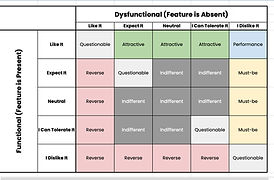
Applied Kano-style questions to identify feature sentiment and priority signals
What this enabled:
-
Identified strongest near-term AI opportunities
-
Surfaced adoption risks and unresolved concerns
-
Informed MVP decisions and future roadmap priorities
PHASE THREE
Based on roadmap priorities and ongoing collaboration with the client, the team shifted focus toward building the MVP.
Findings from earlier AI research continued shaping product and design decisions throughout the process, with concepts incorporated directly into the experience rather than remaining theoretical recommendations.
Research efforts centered on supporting MVP development through concept testing, design feedback, and usability testing. The client had aligned on including two foundational AI features in the initial release, while a growing list of additional ideas emerged as potential post-MVP opportunities.

PHASE FOUR: PLANNING
With design moving into MVP delivery and the client pushing to lead in AI innovation, the goal was to move quickly while still grounding decisions in user input.
Given the variation in needs across industries and setups, we adapted our earlier Kano-lite approach into a short unmoderated survey.
What we did:
-
13 AI features were shown, each with a brief description and visual to support understanding
-
Follow-up questions captured directional feedback on value and fit
-
Survey was sent to both dealers and end users for broader perspective
What this enabled:
-
Faster input without slowing MVP timelines
-
Reduced interpretation gaps in unmoderated testing
-
Provided early directional signals to inform prioritization
PHASE FOUR: IMPACT
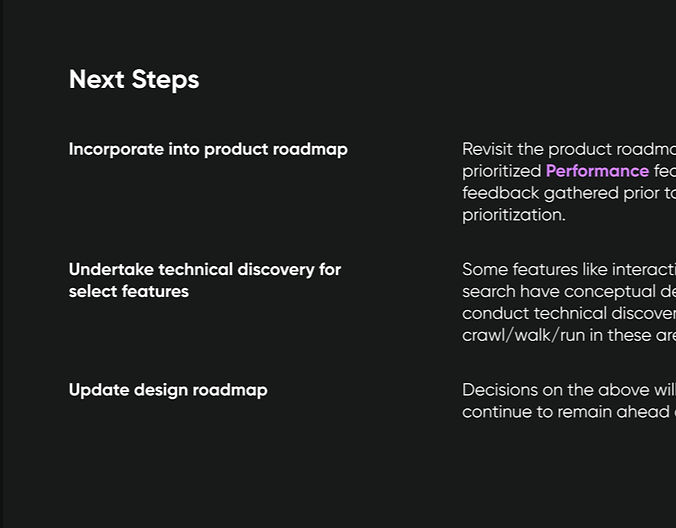
As expected, there was variation across users' responses, but as I synthesized results, I was able to identify a few clear categories to provide directional guidance :
-
Highest-ranking features across both groups, signaling a shift toward baseline expectations rather than differentiators
-
A second tier of features showed cross-group alignment, highlighting strong candidates for focused design investment
-
A low-priority set was consistently deprioritized, enabling the team to confidently defer or remove them
The larger sample and structured methodology gave the team something they could bring into roadmap conversations with confidence.
OVERALL IMPACT
The research grounded business priorities in user insight, creating clear direction for both MVP execution and long-term strategy.
Across all phases, the research provided continuous direction that helped the team move confidently in a fast-evolving, opinion-heavy AI space. Early Phase 1 pillars anchored MVP development, while later findings provided concrete, user-informed inputs for 2026 roadmap prioritization.
Together, this work helped the team:
-
Ground AI strategy in real user needs, not assumptions
-
Identify where AI would be most useful, acceptable, and impactful early on
-
Move beyond feature decisions to shape a broader philosophy for how AI should show up across the experience
The team had shared clarity on where to focus, where to deprioritize, and how to introduce AI in a way that aligned both user expectations and product ambition.